
Not surprisingly, equity investors are bidding-up stock prices across sectors and the broader market is now more valuable than pre-Covid levels.

Indians face COVID-19 with record debt, stalled income.

The combined interest payment for India's top listed companies, excluding financial and oil and gas firms, was up 15.2 per cent year-on-year during the six months ended March 2019, outpacing the change in net sales and operating profit.

On the other hand, the group's two traditional cash cows, TCS and Tata Motors' subsidiary Jaguar Land Rover, are slowing as other businesses pick up pace
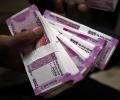
Centre took Rs 1,002 bn from here in 2017-18, sharply up from Rs 904 bn a year before and Rs 123.6 bn in FY14
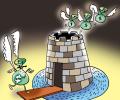
The risk-reward ratio could turn adverse for foreign investors if corporate earnings disappoint by wide margins, or if crude oil prices spike in the international market, putting pressure on the rupee-dollar exchange rate.

The current valuation is 38 per cent higher than the 10-year average of 22x and over 50 per cent higher than the 20-year average of around 20x.

Analysts attribute this fall to the recent moderation in energy (mainly crude oil) and commodity prices, lowering of input costs for companies in sectors such as FMCG, consumer durables, and automobiles, reports Krishna Kant.

The Hinduja Group, Mukesh Ambani, Murugappa, and the Adani groups were the other gainers in the Modi regime, while Naveen Jindal and Sun Pharma groups saw the most erosion in their m-cap in the last five years, reports Krishna Kant.

HUL, ITC, Nestle, Colgate, Dabur, Britannia, Asian Paints, P&G are trading at nearly 48 times. The previous record high was 53 times at the end of March 1994.

Automobile company Tata Motors, metals and mining major Vedanta, oil marketing firm Bharat Petroleum Corporation (BPCL), private sector IndusInd Bank, and two-wheeler major Bajaj Auto have witnessed their market cap slip below the Rs 1-trillion mark this year.

IT major nears $100 bn m-cap, accounts for 61% of the group's combined valuation.

Mukesh Ambani remains the country's wealthiest promoter as his stake in Reliance is now worth Rs 3.25 trillion!

41 companies take back shares worth Rs 27,783 crore in FY17
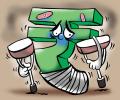
The Indian rupee is down nearly 2 per cent against the US dollar since the beginning of January 2019. Experts attribute the Indian rupee's relatively poor performance to a sharper-than-expected fall in economic growth in India.

The country's top FMCG stocks, such as Hindustan Unilever, ITC, Nestl, Britannia, Godrej Consumer Products, and Dabur, among others, are currently trading at around 41x their trailing 12-month earnings, down from their peak P/E multiple of around 48x at the end of December 2018.

Together, the top 10 business groups reported a pre-tax loss of Rs 19,342 crore during the January-March 2020 quarter, as against a profit before tax of around Rs 48,500 crore in the year-ago period and Rs 39,600 crore during the December quarter. While Vedanta was the worst hit. others included Aditya Birla, Bharti, Adani, Mahindra, and Tata.

Equity investors should thank cash-rich biggies such as TCS, ITC, HUL, Nestl, and Bajaj Auto for this.

The list of companies skipping dividends in FY19 includes some of the country's largest firms and industry leaders such Tata Motors, Avenue Supermart, Future Retail and Vodafone Idea, among others.

After Maharashtra, analysts expect more states like Karnataka and Haryana to slash stamp duty rates. However, analysts, do caution that it's still a long road to recovery for the realty sector.

Though most analysts expect the global central banks to keep the liquidity tap open, valuations of Indian markets, they say, are beginning to look stretched. Against this backdrop, they remain cautious, with some even expecting a minor correction from here on.

The finance ministry has short listed 11 PSUs for a possible buyback of shares in the ongoing financial year

The markets will be eyeing the amendments.

The combined assets of the top five - Tata Consultancy Services (TCS), Infosys Technologies, Wipro, HCL Technologies and Tech Mahindra were down one per cent to Rs 27,7400 crore at the end of 2017-18, from Rs 28,0100 crore a year before.

The benchmark Sensex companies' underlying earnings per share are down 3 per cent (on a cumulative basis) since January 2015, against 25 per cent rise in the index value during the period
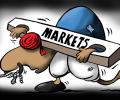
Market cap of government companies has remained unchanged in the past 8 years.

Total net debt-equity ratio improves for third consecutive year, while investment in new projects hits a 10-year low, says Krishna Kant.

So far in 2017, the Nifty has gone up by 22.4 per cent.

Investor Rakesh Jhunjhunwala and his family's net worth in listed companies surges in the recent bull run.

The combined share of customs and excise duties, service tax, and value-added tax in India's gross domestic product reached an all-time high of 10.5%.

'If an investor wants to clone an ace investor's portfolio, s/he will be better off cloning the entire portfolio rather than cherry picking stocks selectively.'

Analysts expect structural risks such as risk to voice revenues, steep correction in data realisations, capex spend and rise in churn and subsequent increase in costs to continue in the medium term

Most analysts as well as company executives say the rally in commodity prices is ill-timed coming just when firms were recovering from disruptions such as demonetisation & introduction of GST

With a loan book of $268 billion, India's retail banking is now ahead of Russia, Malaysia and Mexico but behind China, Brazil and Thailand

Crude oil prices have more than doubled, pushing up India's import bill and raising fears of a higher current account and fiscal deficit. This will impact corporate earnings.

FIIs accumulated India's top-listed companies at an average valuation of around 16 times.

Valued at $71.2 billion, the bank's market capitalisation is more than that of global banks like Barclays, JP Morgan Chase and Credit Suisse.

The sentiment around Indian equities remains positive and unchanged.

FY16 saw the highest number of new product launches in a year from Maruti
 © 2026 Rediff.com - Advertise with us - Disclaimer - Privacy Policy - Sitemap - Feedback - About us - Terms of use - Grievances